Showing 3 results

People & Organisations
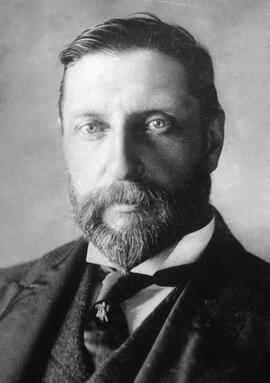
Henry Rider Haggard
Person · 22 June 1856 14 May 1925

an English novelist best known for his romantic adventure King Solomon’s Mines (1885).

He published two unsuccessful novels but captured the public with his African adventure story King Solomon’s Mines. He followed this with She (1887) and further stories of Africa, notably Allan Quatermain (1887), Nada the Lily (1892), Queen Sheba’s Ring (1910), Marie (1912), and The Ivory Child (1916). He used other settings for such striking romances as Cleopatra (1889), Montezuma’s Daughter (1893), and Heart of the World (1896).


  • Haggard was also a practical farmer; he served on several government commissions concerning agriculture and was knighted in 1912 for these services.
  • With Robert Louis Stevenson, George MacDonald, and William Morris, Haggard was part of the literary reaction against domestic realism that has been called a romance revival.
Guy Harrison Baines
Person · 16 September 1911 - 13 December 1985

A friend and contemporary surgeon to Dr. John Herbert Hicks.

The following details are from Dr. Baines' obituary written by Royal College of Surgeons of England.
[Copyright (c) The Royal College of Surgeons of England, Brit med J 1985, 290, 405]

Guy Harrison Baines was born on 16 September 1911 at the Vicarage, St Helens, Lancashire, where his father Albert Baines, a Cambridge graduate, was a clerk in Holy Orders and later archdeacon of Halifax. His mother Mabel (née Harrison) came from Liverpool. After early education at Mostyn House, Parkgate, he went to Charterhouse where he became head of his house and represented his school at football, boxing, athletics and swimming. At St John's College, Cambridge, he secured an honours degree in natural sciences in 1932 and became demonstrator in anatomy and physiology. He was president of the University Medical Society and gained blues for boxing and swimming before becoming Hector Mackenzie Exhibitioner at St Thomas's Hospital in 1933. After qualifying in 1936 he held resident surgical posts at his teaching hospital and took the primary FRCS before moving in 1939 to the new Queen Elizabeth Hospital, Birmingham, where he was surgical registrar and resident surgical officer while completing the final Fellowship in 1939. He joined the RAMC in 1943, becoming a surgical specialist in the First Airborne Division with which he served in North Africa, Sicily and Italy and was then transferred to Burma. There, with a mobile surgical unit, he took part in the Arakan campaign before returning to hospital and field surgical units in NW Europe. After VE day he commanded hospitals at Sandbostel and Belsen concentration camps before becoming officer in charge of the surgical division at No 25 General Hospital. He there met Janet Douglas Ward, a physiotherapist, whom he married just after the war.

In December 1945, just before his demobilisation, Guy Baines was appointed assistant surgeon to the Queen Elizabeth and Children's Hospitals in Birmingham, and surgeon to the Guest Hospital, Dudley. He rapidly built up a large practice in general surgery, with a special interest in urology, and eventually devoted himself entirely to urology. He published valuable papers on ectopic ureter, nephrocalcinosis and abacterial pyuria and became an active and popular member of the British Association of Urological Surgeons. A man of strong and handsome appearance, a conservative but skilful surgeon, his courtesy, charm and kindly consideration for his patients caused him to be in constant demand. Shortly after their marriage he and his wife settled on a 100 acre farm in Worcestershire, where they raised a family of four children and kept a fine dairy herd. After suffering a myocardial infarct in 1970 he sold the farm but continued with his surgical work until normal retiring age in 1976 when he took up market gardening and served on medical tribunals. He loved the country life but later suffered increasing cardiac disability until his sudden death on 13 December 1985, aged 73. An unselfish and generous man of assertive character, his cheerful temperament and wide interests made him an excellent colleague and staunch friend. He was survived by his wife and by his two sons, Robert and Michael, and two daughters, Rachel-Claire and Julie-Anne.

Corley, Hugh Vanner
Person · 7 October 1914 -19 October 2002

An amateur botanist from Pucketty Farm, Faringdon, England.

Born in South India in 1914. He left India at age 4 to attend school in England. Eventually attended Marlborough College and Oriel College, Oxford, with a degree in zoology.

After a brief period in the army, he took up farming, working as a pupil on a farm near Kelmscott. In 1938, Hugh bought Pucketty Farm in Faringdon. He became an organic farmer and eventually published a book on the subject. Many people would come to his farm to learn about organic farming.

During WWII, Hugh was told by the Gloucester Regiment that they did not need him, so he resigned his commission and continued farming. He joined the Home Guard.

In 1950, Hugh became interested in ferns when he happened upon a very rare fern by chance. For the next 50 years, he dedicated himself to the study of ferns. He joined the British Pteridological Society in 1962 and began to specialise in Dryopteris. He was the first to suggest formulae (e.g. AB, AAB) for the possible combinations of genomes in what later became the subspecies of Dryopteris affinis, work that is still being continued today. President of BPS, Stanley Walker, lent him an old microscope so he could check spores.

Hugh would carry out fieldwork in Southern England and Wales on the weekends when the farming calendar would allow. In 1982, while fern hunting in Kintyre, he made the first discovery of Dryopteris x sarvelae outside Finland.

Hugh built up a living fern collection at Pucketty. Care of his ferns was his top priority, and they were well taken care of. Many of his plants were later studied in depth by Stanley Walker and Mary Gibby at the BM. Under Walker's tutelage, Hugh quickly learned to detect the exact stage when developing spores could be stained to show their chromosomes.

Hugh was a kind and generous person who was always willing to help anyone who showed an interest in ferns. One such person was a young student from Radley College, Christopher Fraser-Jenkins. They developed a long-lasting friendship, and Christopher would go on to name a species of Dryopteris after Hugh: D. corleyi.

In his 70s, Hugh trained as a chiropractor, being one of the first students of John McTimoney, founder of the Oxford College of Chiropractic. Hugh built on McTimoney's work.