
DOW
·
Person
·
1811-1892
GB/NNAF/P136241
·
Person
·
1799-1834
Born Perthshire 1799; died Hawaii 1834
David Douglas was apprenticed at the age of ten in the gardens of Scone Palace, Perthshire; in 1818 he became under-gardener at to Sir Robert Preston at Valleyfield near Culross, from where he moved to the botanical garden at Glasgow. There he attended the botanical lectures of William Hooker who he accompanied on several expeditions to the Highlands. Hooker recommended Douglas as a plant collector to the Horticultural Society of London and in 1823 he was sent to the eastern United States and Canada and then in 1825 to the Pacific North West where he spent two years in pursuit of new species of plants, birds and mammals along the Columbia River. Returning to England, his rich collection of live plants was greeted with great enthusiasm by the botanical world. In 1829 he returned to north west America, first exploring the interior of Oregon and Washington, then collecting along the Spanish mission trail in California. In 1833 he sailed to the Sandwich Islands, arriving in 1834 where he met his death on the slopes of Mauna Kea on the island of Hawaii when he fell into a pit trap and was gored by a wild bull. Douglas made over 200 introductions including the Douglas fir Pseudotsuga taxifolia and the sugar pine Pinus lambertiana. His introductions can be seen in many of great houses of Britain. Most of the ‘big trees’ at the Younger Botanic Garden, Benmore were introduced in the first half of the nineteenth century as a result of David Douglas’s explorations and some of Dawyck’s largest conifers were raised from Douglas’s original seed collections.
Sources: Dictionary of National Biography; R. Desmond ‘Dictionary of British and Irish Botanists and Horticulturalists; Deni Bown, ‘4 Gardens in One’; Ann Lindsay and Syd House ‘The Life and Explorations of David Douglas’.
D.W.
Person
Person
Person
·
29 August 1923 -
sister of the Queen Grandmother and grand-aunt to the current King (as of September 2026), was born in Bhutan House in Kalimpong on 29 August 1923, the daughter of Gongzim Sonam Tobgye Dorji and Sikkim Princess Choying Wangmo Dorji.
In 1952, she was sent by the Third King, His Majesty Jigme Dorji Wangchuck to eastern Bhutan to help the people who were being harshly taxed by local rulers, empowering her to give Kidu (land) to the Zaps and Tayps (landless classes). This became known as Ashi Tashi Thram and stopped the mass exodus of Bhutanese from the east to India.
In 1962, Tashi represented her brother Jigme Palden Dorji, the Prime Minister of Bhutan, at the 14th meeting of the Consultative Committee of the Colombo Plan, held in Melbourne, Australia.
On 11 July 2018 Ashi Tashi Dorji was the first Bhutanese national to be made an honorary Officer of the Order of Australia, in recognition of establishing strong ties between the two countries.
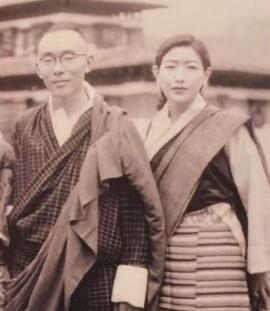
Person
·
14 December 1919 - 6 April 1964
Son of Sonham Tobgye Dorji. Became 1st offical Prime Minister of Bhutan (and first to hold the title, Lyonchen). Brother-in-law of Jigme Dorji Wangchuck. Was assassinated in April 1964
1928, at the age of nine, was appointed the Trungpa (Administrator) of Haa Dzongkhag
1953, he succeeded his father Raja Tobgay, after his death, as Bhutan Agent to Kalimpong.[6] He became the first man to hold the title Prime Minister of Bhutan (Lyonchen).
Person
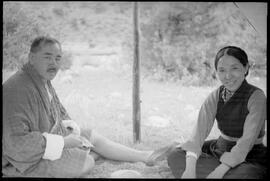
Person
·
1897-1994
Princess of Sikkim, daughter Chogyal Thutob Namgyal, the 9th consecrated ruler of Sikkim. (Bhutia 1994: 57) Mother of Queen Grandmother Ashi Kesang Choden of Bhutan. Wife of 2nd Prime Minister Sir Raja Sonam Tobgye Dorji.
In her early years she was given an monastic education.
She is best known for designing the flag of Bhutan.
5 April 1918, marries Sonam Tobgye Dorji of Bhutan. They had five children: his eldest son Jigme Palden (1919-1964) who became Prime Minister of Bhutan; the second eldest, a daughter Tashi (b.1923), who helped in the affairs of the Bhutan House; Kesang Choden (b.1930), who married the third King of Bhutan; Ugyen (1933-2006), a reincarnation of a high priest in Tibet; and Lhendup (1935-2007). The children were all born and brought up in Bhutan House and educated in the elite schools set up by the British within Darjeeling and Kalimpong. (Khandu-Om Dorji 2008:10)
Was deeply religious and a scholar with an interest in the history and culture of Bhutan. Was also knowledgeable about the history and cultures of Tibet and Sikkim. She was a founding member and took an active role in the Sikkim Research Institute of Tibetology (SRIT), Gangtok, Sikkim. From 1964-65 she was co-opted in the General Council of SRIT. (Bhutia 1994: 59)
In memory of her husband, Mayum was commissioned by Jigme Dorji Wangchuck (third king of Bhutan & Mayum's son-in-law) to write the Kanjur and Tenjur, comprising of over 300 volumes of sacred teachings and expositions of Bhuddha in gold lettering (Bhutia 1994: 57)
She funded the construction of many Lhakhangs (temples) and the renovations of monasteries. (Bhutia 1994: 57)